Saturday, January 22, 2022

Can You Hear me? - By RBL


Can You Hear me?


This is my first blog post for my Disease class. This first unit was based on anatomy and learning about how different diseases can impact the human body. We began the class by looking at the main body systems. After that, we went on to talk about how different cancers could affect each system and how the systems could fend against them. We then split into smaller groups to look at the City Health Dashboard website. On the dashboard, we researched different diseases and different problems that are affecting the city and how corporations are fighting against some of the conflicts. This all led to our Action Project, which is to interview someone about a specific disease that they have or that they’ve had and talk about what parts of the body this disease affects. Hope you enjoy it!


Patient profile:


For this action project, the disease that I decided to study was otosclerosis. Before we get into otosclerosis we should talk about what sclerosis means. Sclerosis means that a bone is over growing. Otosclerosis is an ear disorder where a new bone forms around the insides of the ear which can cause hearing difficulties.


Medically the types of people who have the biggest risk of getting this disease are women of all ages. It can also be passed down through different genes from family or can develop while a person is pregnant. Another way this disease can develop is through overgrowing of bones inside the ear. When a bone isn’t growing the right way, it can also cause otosclerosis. This disease manifests as possible changes in bones and bone structure. It isn’t a communicable disease. Although people can’t see otosclerosis directly, they can notice if someone is having hearing issues. This disease directly affects the vestibular system which is a subset of the nervous system. The system itself receives soundwaves that allow us to hear. An example of how this disease can affect someone is if they are watching television and notice that they can’t hear clearly. Because of this they might have to resort to other means to improve their hearing. Some of the factors that can cause this disease are lack of water, measles, and sometimes the reason behind the disease can be unknown. This means that this disease is multifactorial.


Personally, I have a family member who has had otosclerosis for years. Currently she is an Assistant Professor of Instruction at Northwestern University. When I interviewed her, she told me her symptoms first started when she was in her mid 30’s. Based on the fact that she was a woman in her mid 30’s, it suggests that she was at a high risk of getting the disease. She noticed that when she was talking on the phone her hearing felt like it was starting to fade. When she first went to her doctor, she was told that her hearing was fading on each ear.

Here’s an example of what otosclerosis might look inside of my family member’s ear:


“Otosclerosis drawing” drawn by RBL January 19th 
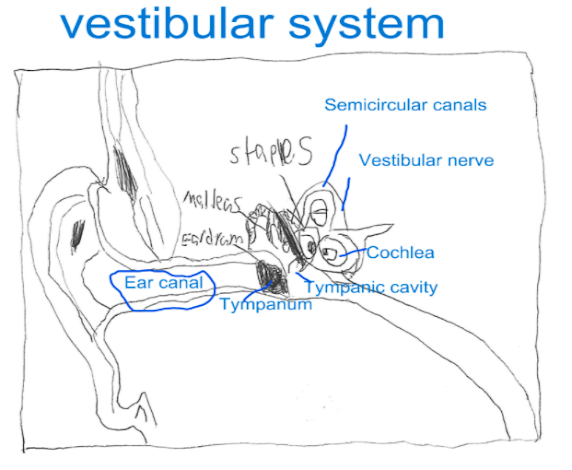
After hearing from the doctor at that time, her hearing loss wasn’t too significant. 4 years later her symptoms only got worse. She then decided to go to a different doctor. Some of the diagnostics she took in order to find this disease were to take hearing tests in order to test inner ear vibrations. After doing a hearing test she was diagnosed with otosclerosis. The bones that are a part of the vestibular system grew too big which caused a lack of vibration in her ears. With minimal vibrations, it made it really difficult for her to hear. In my family member’s case, the doctor gave her two options for treating her disease. One option was a stapedectomy. A stapedectomy is a surgery where doctors replace the bones in your middle ear with prosthetics that are artificial materials so the ears can get that vibration. At that time, my family member hadn't had any good experiences with surgeries, so she wasn’t thrilled with getting one. So, she decided to get hearing aids instead.


 Here’s an example of the kinds of hearing aids she wears:

"Receiver-in-the-ear open ear Oticon hearing aids" by ikesters is licensed under CC BY-SA 2.0

She told me that, “I was also really embarrassed to wear hearing aids at first. I first wore hearing aids for a practice period similar to having glasses.” My family member still wears hearing aids today and told me that she’s ok with wearing them because they improve her hearing significantly. With better technology the hearing aids will get better too.

Closing thoughts:

Overall, I enjoyed doing this action project because it allowed me to learn more about my family member’s life with this disease. It also made me think about how different diseases can impact people's lives and the people around them. It also pushes me to understand how her disease might affect her and how I can help her and understand how to see her thoughts.


Sources:


H.P personal interview

Noted January 16, 2022


The Royal Victorian eye and ear hospital. (n.d.). Ears - otosclerosis. Ears - otosclerosis - Better Health Channel. Retrieved January 21, 2022, from https://www.betterhealth.vic.gov.au/health/conditionsandtreatments/ears-otosclerosis

Wednesday, January 19, 2022

STOP PLAYING GAMES - By RBL

 STOP PLAYING GAMES


Hello this is RBL and welcome to another blog post. This is my first blog for my Forbidden Books class. For this first unit our main topic was Politics. To start off we looked at Socrates, and how his thoughts and reasoning changed others. One of the biggest things that I learned from him is the Socratic method. The Socratic method is a process of asking a series of difficult questions in order to understand someone's reasoning. Now this process was so powerful that he even passed his methods onto children, who ended up questioning other people in their society. Socrates was sentenced to death for passing on his advanced thoughts to the youth. Parts of this method still affect our thoughts today. This led to my class action project this term, which was to create an original Socratic method video. For this video I worked with my partner KT. We both like playing different games which inspired us to create a video based on video game addiction. For this we had KT being the Socrates based character who will be asking different questions about games. I will be the person with the outrageous statement who will be answering the questions KT asks. Here's our video about how the Socratic method can be shown through video game addiction, I hope you enjoy.


Video script:


Zenyatta

“Hey what are you doing”


Brooks

“I'm just playing sonic 1 on my phone, it’s one of my favorite games to play on my phone.”


Zenyatta

“Since there are a bunch of sonic games, what makes Sonic 1 your favorite?”


Brooks

“Well, I’m not sure if it’s my favorite sonic game on mobile, but it’s what I find myself playing the most.”


Zenyatta

“How long do you play on a daily average?”


Brooks

“Not that much. I guess I play 7 hours a day. I do sometimes play different games on my switch or my playstation, but my phone is the thing that’s most accessible to me. That’s why I always find myself coming back to play it.”


Zenyatta

“That's a lot of time spent on a video game. I was reading off Dr.K’s website. He’s a Harvard trained psychiatrist who states that 8.4% of children and teenagers are addicted to gaming. Do you think it changes how much time you spend with friends and family?”


Brooks

“No. I spend plenty of time with my family.”


Zenyatta

“Ok. so, you spend 7 hours in school, 7 hours on sonic, and 7 hours sleeping, that’s 21 hours! How are you able to make time to spend with your family?”


Brooks

Woah, that’s a lot more hours than I thought. Maybe I do spend too much time running around in those levels.


Zenyatta

“Well, I think that it’s important you’ve recognized that. So, what are your next steps?”


Brooks

“I think my next steps are to maybe spend less time on my phone. Maybe like setting times for myself when I could play. Now that I think about it, I’m addicted to playing games on my phone.”


Zenyatta

“I believe you may be. Do you think you could play a bit less?”


Brooks

“Well, I think that’s something that I could try doing, maybe instead I should try and get out a bit more and do more active things. Maybe that way I could find new hobbies besides just playing on my phone.”

Wednesday, December 15, 2021

The Better Bag - By RBL


The Better Bag


Hello my name is RBL and welcome to my blog for my school class biomimicry. If you don't know already biomimicry is looking at nature and seeing how we can learn, or adapt based off of it. In the start of this class we got to learn about plants and animals. Along with that we also got to look at some of the simple lessons that nature can teach us. Some of the lessons that I got from nature are being aware of water temperature, recycle carefully, and be careful of what you eat. For the class itself we also had field experiences where my class had the chance to get outside and see nature first hand. To learn about plants we went to the Lincoln Park Conservatory. Along with that the next day we got to go to the Lincoln Park Zoo to learn about how animals can adapt to nature as well. We even went to Plant Chicago where we got to learn how some people used different concepts of closed loop systems. This led up to our action project where we get to research organisms of our own choosing and see how we as humans can learn from them.

Here's my adaptation below:


The species that inspired me was hemp or Cannabis sativa. It can grow constantly and quickly. It's leaves and stems are short and leaf like. It also has been able to adapt to not produce as much THC compared to some of its other family members like marijuana. So over time hemp has grown to need less and less of the THC which is better for us because it won’t make us high. Hemps can be found in warm and humid climates like grasslands, mountains, and blustery deserts. Overall it can be grown in a lot of different places except winter climates. Now the main thing that makes hemp really unique is that it can be used in many different ways. The part that can give the most use is the fibres. To get these fibres the stalks have to dried, crushed, and shaked until the fibres are released from the stalks. These fibres are strong, and resistant to a lot of things which is where most of hemps fertility comes from. For example these fibres can be used to make t-shirts, cooking oils, or possible beauty products.

My closed loop cycle:


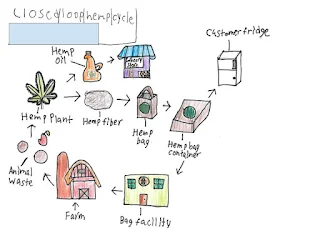
My solution for this is a closed loop cycle of making hemp based bags. I wanted to do this cycle because plastic bags are a thing we use everyday. Even so it's really bad for the environment because they take 10-20 years to decompose. With this idea it gives us a way to be more sustainable. Now the cycle starts with the hemp based plant and when when the hemp grows some of it will be sent to factories to be burned and made into cooking oils which will then be sent to grocery stores. The rest will be taken to a harvesting facility where the hemp fibers are harvested from the stems. Once these fibers are harvested they will then be turned into hemp based bags.

These bags will be stored in a relative temperature of 30-40 degrees Fahrenheit so they can degrade as slowly as possible. These bags will have an expiration date of 1-2 years and it will be placed on the insides of the bag. This is so customers and buyers can know when their bags will start degrading. Along with that on the expiration date I’d hope to put an address to a farm where the customer could send the degraded bag to. The bag will be 17 inches tall, 17 inches long, 9 inches wide, and a handle of 28 inches. When sending bags to stores they’ll be placed into a cardboard container. After the bags are sent it’s up to stores how they want the bags to be sold. My main goal for them is to serve as bags for everyday use. Customers can refrigerate their bags to make the bags last longer when not being used.

Once a bag finishes its degradation process customers can place their degraded bag back in the store container they got their bag from. Before a consumer might place the bag into the container I’d recommend that they either put the bag under cold water to wash it, or wash it in a washing machine. Once the container is full of the degraded bags it will be sent back to the bag facility so the bags can be disassembled. Once the bags have been disassembled the hemp fibres will be used as food at farms for animals like cows and horses. This is what makes my design a bit more unique compared to companies like Hempalaya because these bags post degradation could be used as a food source. When those animals then produce waste the waste will be used to then regrow new hemp plants so the process will continue. When new bags are made they’ll be sent back to stores so customers can receive new bags.


Now before I created this cycle I found out about Hempalaya hemp bag company. Their work was so similar to my own design that it made it hard for me to think about how I could make mine unique. That's when I decided to incorporate the bags into food for a farm so this process could become circular.


Here's how it looked at first:


Concept Hemp bag closed looped process (Drawn December 14th, 2021) By RBL


After doing some rewriting and finalizing my cycle here's a picture of it below:


Closed loop hemp bag cycle (Drawn December 15th, 2021) by RBL


Life's Principles:


When looking at this design I decided to learn from Life's Principles, which are a set of rules or guidelines that nature sets itself to. I found that my design hits two of the principles:

Be locally attuned and responsive - My design is using that by having customers fill out a survey that can allow them to share their opinions about the product and allow them to share how I could improve the design.

Be resource efficient - My design works with being resource efficient because of because of it’s closed looped concept. Closed looped means that every single part of my design can be a food or resource for another part of it. My design also doesn't have to rely on common things like fossil fuels because everything can be recycled.

An SDG connection:

The SDG's (sustainable development goals) are goals set by the United Nations to help improve the world around us. The goals that my design hits are:

SDG # 12 : Ensure sustainable consumption and production patterns

Target # 12.5 : By 2030, substantially reduce waste generation through prevention, reduction, recycling and reuse.

My main connection to this is that my hemp bags are trying to reduce the waste of things like plastic grocery bags.

Is it a part of of the circular economy?

My design is a part of a circular economy because all of the parts of my design can be put back into one another. For example, how when my bags are finished degrading they can be sent to a farm and can serve a new purpose. One possible idea I could use to power my facility freezers could be solar panels. The power from the sun could possibly be used to power the fridges that keep the bag containers cold in the facility.

Final conclusion:

Overall this unit was really enjoyable to me. This is because I managed to learn about animals and nature in ways I could never think of. For example like on our first day and observing trees around us and seeing the simple ways we can learn from them. This course also was able to get me to go outside, and thinking how simple things that I do everyday could affect entire ecosystems. I also enjoyed putting up this idea of a closed looped system and seeing how it could be shown in a good way. If I was to do this again I would probably try to do something a bit different with the hemp because it can be used in a lot of ways. Now I want this to serve as a wake up call to you. Originally I wanted to make this action project because of grocery bags getting caught in oceans and not serving a common purpose. Because of this I wanted to make these bags the way they are. Nature is a beautiful thing we all can learn something from it. So get out into nature, and see how you can learn from it yourself.


Sources:

Theodoredouc, Doucette. “Replacement of Plastic Bags with Reusable Hemp Bags.” Debating Science, 23 Apr. 2019, https://blogs.umass.edu/natsci397a-eross/replacement-of-plastic-bags-with-reusable-hemp-bags/.

“Hemp Livestock - Hemp Foods.” Hemp for Livestock, Hemp Foods Australia , https://www.hempfoods.com.au/assets/uploads/2014/04/Hemp-Livestock.pdf.

“Waste Not, Want Not: Recycling Hemp & Cannabis Bio-Waste.” Ministry of Hemp, 26 May 2020, https://ministryofhemp.com/blog/recycling-hemp/.


Wednesday, November 10, 2021

War on X final reflection - By RBL

War on X final reflection

Hello, this is RBL and welcome to my final thoughts about my class, War on X. In this blog post I'm going to go back and look at everything I've done in the course, and looking at the things I liked and disliked about it. Like most of my classes in school I had three different units. In each unit we did research and talked about different political topics that we see as important. Some of those topics were, incarceration, critical race theory, and doing group based research on different topics as well. 


Tuesday, November 9, 2021

Black rhino's population change - By RBL

Black rhino's population change - By RBL


Hello this is RBL and welcome to my last action project blog for my population class. In this blog I made a video talking about the black rhino's population, how's changed overtime, and how humans have changed their population growth. Here's the video and I hope you enjoy it.


Please note: If the video doesn't load in my blog, please click the made with clipchamp button to view my video in a separate tab.

Sources: 


“Black Rhino Population.” Our World in Data, Global Change Data Lab,

https://ourworldindata.org/grapher/black-rhinos?time=earliest..2017.


Kurnit, Jennifer. “Diceros Bicornis (Black Rhinoceros).” Animal Diversity Web, University of Michigan, 2009, 

https://animaldiversity.org/accounts/Diceros_bicornis/. 


“Black Rhino.” WWF, World Wildlife Fund, https://www.worldwildlife.org/species/black-

rhino#:~:text=Human%20activities%20such%20as%20agriculture%2C%20settlements%2C%20and%20infrastructure,threats%20facing%20black%20rhinos%2C%20poaching%20is%20the%20deadliest.


What makes a hero? - by RBL


What Makes a Hero?


Hello, this is RBL and welcome to my third and final action project for my class called Stories. In this unit, we learned about the theories of the hero’s journey and how different characters change throughout different stories. If you don't already know, the hero's journey is a theory made by Joseph Campbell. It is a theory based on the idea that most known heroes in common literature go through. Connected to that, we also talked about the different ways the hero's journey can be different from one another. We also got to talk about different plots for a hero's journey as well. For example, one of our field experiences was watching the movie, "The Matrix" to get a better look at the hero's journey in a really popular movie. We also got to go to Armani's Howard's art studio to see how he encapsulates the hero's journey in his art. This all led up to our action. In this action project, I'm going to take a fictional hero and compare it to a hero I know in real life.


The fictional hero that I chose was Morpheus from The Matrix movie. I chose this hero because I really liked his journey throughout the first movie and seeing the ways he grew. His mentor relationship with Neo is very entertaining to watch and see how it changes throughout the story. Morpheus taught Neo a lot of important lessons throughout the movie which led to Neo using some of those things to save Morpheus in the end of it. Morpheus in the Matrix was always a very calm and relaxed person and is able to fix a lot of problems under pressure. Now along with my fictional hero, I had to choose a nonfictional hero that I know in real life. The hero I chose for that was JS; JS is a social worker and therapist. I wanted to choose him because I get along with him really well. JS also helps me overcome a lot of my own personal challenges like Morpheus does for Neo. Like Morpheus, JS helps a lot of people overcome different hardships in their lives so they can move on for the better. In their journeys, they are not only fighting for themselves, but are fighting for others against something that is bigger than just the two of them.


The main part of my action project was to create a visual representation of the journey that my heroes went through. Here’s a link to the Prezi I created based on the hero's journey. I hope you enjoy the journey!

https://prezi.com/p/cfm-1ebqkgfd/?present=1


Monday, November 8, 2021

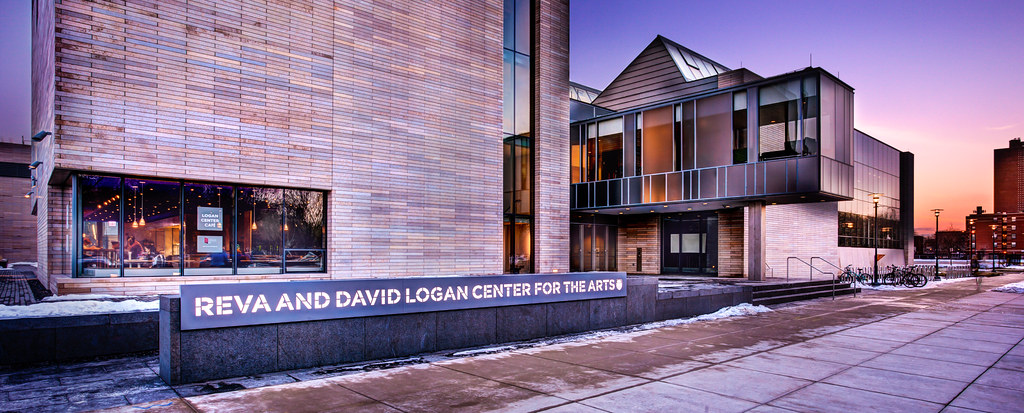
Volunteer hours at the logan center

Volunteer hours at the Logan center

Hello this is RBL and in this blog I'll be sharing my experience volunteering at the reva and david logan center for the arts. I personally really enjoyed my experience working there for the time I did. During the day I helped to lay out story books so the families who came to the event had something fun to do. I also got the chance to work at the front desk to explain to families how the event work and provided them a good experience.

Logan Center for the Arts

Thursday, November 4, 2021

A trip to Guatemala - By RBL

 A trip to Guatemala

hello this is RBL and welcome to this blog post. This action project was for my spanish class where we were supposed to create a travel pamphlet. For the pamphlet we all got to choose a different country to learn about their foods, activites, and things you can do in the country. We also had to show different places you could stay or see in the country as well. I chose Guatemala as my country to research for the project. Here's my pamphlet below and in english as well as spanish:

English pamphlet:


Spanish pamphlet:


Sources:

“10 Top Tourist Attractions in Guatemala.” Touropia

https://www.touropia.com/tourist-attractions-in-guatemala/.

LUNAS , DOS. “The Guatemalan Breakfast.” Dos Lunas Airport Bed & Breakfast/Hostel, 24 

Jan. 2019, https://www.hoteldoslunas.com/the-guatemalan-breakfast/. 

Marshall, Cassie. “Guatemalan Food: Our 25 Most Popular Guatemalan Dishes.” The Kitchen 

Community, International Foods, 31 July 2021, 

https://thekitchencommunity.org/popular-guatemalan-dishes/. 

“Real Intercontinental Guatemala.” Expedia Travel: Vacation Homes, Hotels, Car Rentals, 

Flights & More,

      https://www.expedia.com/Guatemala-City-Hotels-Real-InterContinental-Guatemala.h558105

Thyberg, David. “Traditional Food of Guatemala.” USA Today, Gannett Satellite Information 

Network, 15 Jan. 2019, 

https://traveltips.usatoday.com/traditional-food-guatemala-12595.html. 


Friday, October 29, 2021

A crested toad timeline - By RBL

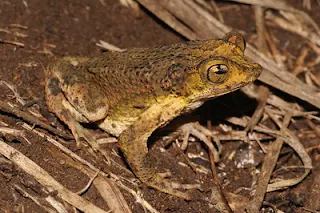
 The Puerto Rican crested toad 

Hello and this is RBL, in this blog I will be looking at the interesting timeline and outline of the Puerto Rican crested toad. I chose this species because I’ve always liked how they look. I also think that they look very unique in lumps on their skin as well.

Puerto rican crested toad (male) - "Puerto Rican Crested Toad, male / Sapo Concho Puertorriqueño,macho" by USFWS/Southeast is licensed under CC BY 2.0 Taken on May 14, 2009


What is the Puerto Rican crested toad?

In Binomial Nomenclature, the spider crab is seen as the Peltophryne lemur. It’s the only toad to be native to different parts of Puerto Rico, but hasn't found anywhere else since.


How have they changed overtime?

They were first found in the northern parts of the karst belt. The Karst belt is a wetland that lives almost entirely off different karst for its water supply. Karst itself is an underground cave-like center The karst region harbors the richest biodiversity in Puerto Rico. Over time the numbers of the crested toad slowly began to dwindle lower and lower. This was until 1931 where they were thought to be extinct for a very long time. This was likely because of their environments changing slowly around different points in those different years. This was until its rediscovery in the northern part of the island in Isabella and in 1974 was found in Quebradillas in Puerto Rico. This was because they were able to adapt to their different environments so they could survive throughout the years. Then a decade later in 1984, the southern population that we know today was found in the Guánica Commonwealth Forest and in 1987, the crested toad was listed by the USFWS as a species threatened for extinction. Today the Puerto Rican crested toad population is slowly growing in size from 300 total to 3,000 of them.


The Golden toad - "Golden Toad" by StanfordWoods is marked with CC PDM 1.0 Taken on May 14, 2009

An extinct relative:

One of the ancestors of the Puerto Rican crested toad is the Costa rican golden toad. The golden toad is now extinct because of environmental causes like climate change, as well as fungal infections. Compared to that the Crested toad did go through some of those environmental changes as well, but was able to adapt to their circumstances so they could survive even up to today. One thing they do have in common is that they are both amphibians, and their eyes are similar in color and size.


Questions for the organism:

Before I got into scientific research I had to look at a few questions to help me look at the Puerto rican crested toad in a few different ways. Here are my responses to each question below:

1. What temperature do they live in?

One article that I looked up that stated this information was by Javorka, Julie titled “Peltophryne Lemur (Ridge-Headed Toad).” This article states that the remaining crested toads live in different parts of the southern forests of Puerto Rico. The climate ranges between from 81 to 85°F and 66% to 83% in humidity. 

2. What makes these toads unique?

The article I looked up to find this information was "Puerto Rican Crested Toad, Facts and Photos" by National Geographic. It gives out two specific things that make the crested toad unique. One of them being their large golden eyes that can help it to see at night. The other fact being that it’s the only toad to be native to Puerto Rico.

3. My quantitative question being,what's the average length of a puerto rican crested toad?

Depending on the gender the size of the Puerto Rican crested toad can be 4 inches for females and 3 inches for males. To give me more options I will convert to millimeters instead of inches, that makes the range 76 - 102 millimeters.

Tuesday, October 19, 2021

CRT in Public Schools - By RBL

 CRT in Public schools

hello this is RBL here with another blog post. This blog will be based around a video that I've created. It's based around the topic of CRT (critical race theory) that we've been talking about in my class the war on X. I will also post my script under the video if needed. Without further to do, here's my video and I hope you enjoy it.


Video Script:

Critical Race in Theory (CRT) in public schooling 


Over the past 2 weeks in my class War on X, we’ve been studying different aspects of CRT. In this video I’m going to be doing some more research on the topic of CRT.


Slide: What is CRT?


  • CRT is the study of different racist acts in the United states and seeing how racism was built into different institutions and has evolved from it.

  • Today it’s seen as the study of race and the different topics connected to the impact of race. With this in mind some schools now want to teach students about CRT and the impacts of racism in the United States.


Transition to next slide: Defined Research 


  • Now that we’ve established what CRT is, I want to look at a specific question based around CRT, "Why did schools ban the teaching of CRT?"


Transition to next slide: Peoples thoughts 


  • One reason why schools are banning CRT being taught in schools is because some parents are hesitant on having their children be taught about CRT for a variety of reasons. One of those reasons is having students learn about race and who they are as an individual.


  • I believe that schools banned teachings of CRT because states thought that if students were learning about each other's races, it would possibly cause conflicts inside the classrooms. There are problems with banning CRT’s process in public schooling. At some point students might see something on the news or experience something that might open them up to race. One of the articles I looked up was, “Here’s what Black students have to say about 'critical race theory' bans”. In this article it states that the battles around the teachings   of racism in the nation’s public schools have risen in the past few months. With this at least five states passed different bills to ban educators from teaching about racial equity. The problem with this is that if we don’t teach students about CRT,they might not be able to understand the different contexts and issues that have to do with race and how it impacts their own identities. 


Next slide: A different perspective

  • I first looked at an article on why CRT was banned in Florida titled “Why Is Critical Race Theory Being Banned in Public Schools”? Governor Ron DeSantis of Florida, wanted to ban CRT education in public schools because he states that he wants students to judge others based on their actions, or in his words "character education." 


Next slide: Should CRT be banned?

  • I still stand that CRT shouldn’t be banned because it’s important that children get to see each other the way they are and to be accepted as young individuals. I also believe that it should be taught in schools because it’s a term that not a lot of students my age know about so it’s important that they should learn about it as well. If students aren’t taught CRT in schools, where else would they be able to learn about critical race theory? An article by James E. Causey also talks about why CRT should be taught in Wisconsin schools stating that, “You can’t teach a sanitized version of race and racism and expect anything to change.” 


Closing:

  • Overall CRT has been a topic that has continued to cause controversy overtime. It can become harder and harder for students to not get exposed to it. It’s up to us to educate students about CRT so they can understand it for themselves. Thanks for watching.

Sunday, October 17, 2021

Fable Making - By RBL


Fable Making- By RBL

Hello this is RBL and in this blog I will be sharing a fable to you all. Before I do so I made this fable based off a class I'm taking called stories. Fables are shorter stories that usually have animals as the main characters in them that all have a shared lesson. Fables are also important to a lot of cultures and organizations like the national association of black storytellers (N.A.B.S). There important to them because they might show a lesson or moral that the culture might see as important to them fables give the culture something to live off of. If you don't know what a moral is, a moral is a lesson of a story or something a fable is trying to convey. We also had to learn about anthropomorphism, which means to give different animals human like characteristics. We also had my mother Emily Lansana come into our classroom and share some of her stories to us. My Mom is a professional storyteller an has been telling stories to people for many years. This leading into this action project, that being to create a fable. 

This fable is about two wolves who is in search for a cure for his mother's sickness. They both go different ways to find an answer for their problems through experience. Thanks for viewing my blog and I hope you enjoy this fable.

The Compassionate Wolf


Long ago, a wolf named Cassidy lived near soft snowy grounds. His name meant that he was compassionate and clever. Cassidy always practiced sharing food for the good of his pack. His sister, Ellis was cunning and always put herself before others. Their mother Vixen cared for both of them since they lost their father, the pack leader, due to an avalanche that crushed his body under the snow.

One day Vixen fell ill with the parvovirus, an illness that affected wolves far and wide. Vixen spent her days in their den. The other wolves protected her while she was sick. When she was ill, Vixen whispered to her children, “My children, I have fallen ill with parvovirus. You must find a cure for me. Whoever finds a cure for my parvo shall become the new pack leader.” This news startled Cassidy and Ellis into a frozen shock, but since Vixen would be taken care of by the other wolves, they were both confident to search for a treatment for their mother. Early the next morning, when the winds were at ease and the air was as calm as the quiet streams that flow, Cassidy and Ellis went in separate ways to find a cure for Vixen.

Cassidy ran to the owl tree. The owls made the best medicines in the land. Cassidy inquired of the owls, “ Oh wise Owls, my Mother has gotten parvo and could die if I can not find her a cure, will you please give me a treatment”? The owls were not certain if they could trust Cassidy. They were worried that Cassidy might eat them all for a good morning breakfast. So the red owl flew down to Cassidy and declared, “We cannot trust you just yet so we shall give you a test. If you succeed we shall give you the cure you need”.

 
Cassidy and the Owl test By RBL, made Oct 16th, 2021 

The red owl flew out of the tree and came back with a huge piece of fish. The red owl gave the fish to Cassidy and when he did, the green owl and the blue owl flew onto two different trees. “I’ve flown these winds for as long as I’ve lived. Over time my wings have become slower and harder to use. Please give me that fish so my wings will feel good as new.” The owl in green suggested. Then the owl in blue harshly demanded, “I’m the fastest owl in these trees, not even that owl on the left could surpass me. I must stay the fastest, and with that fish I’d fly as far as the mountain in an instant.” After hearing the owls' cases Cassidy made a decision. “I shall give this fish to the Owl on the left, he needs it more than the other so he can fly once again.” “Correct,” the red one declared. “Now that you have passed our test, we shall give you the treatment to cure your mother’s sickness.” The Owl with red feathers gave Cassidy a small wooden bottle containing the fluid needed to make her strong once again. “Thank you wise Owls, I shall bring it to my mother so she’ll have strength once again.” Cassidy then went back through the forest so he could bring the medicine to Vixen.


While Cassidy was on his way back to his pack, Ellis went to the polar bear igloo. When Ellis got there she told them harshly, “Hey polar bears I’m looking for medicine for my sick mother, give me some now before she's gone for good or I will steal all your food so you will rot away from starvation!” The polar bears were shocked by the disrespect Ellis had shown them. Then Pola, the biggest and strongest of polar bears, walked up to Ellis and said, “ We won’t let anyone come into the Igloo and show us such disrespect.” They then pounced on Ellis for her actions. She shrieked so loud that even the birds could hear her from the top of the mountain peaks.

When Cassidy returned to the pack, he was commemorated for giving Vixen the medicine and showing the skills needed to conquer the tasks that the owls gave him. The polar bears later brought Ellis back home and explained why she was injured. After that Ellis was in the den for months on end trying to heal from her mistakes. Cassidy became the newest pack leader and remained the pride of the pack for many years to come.


Moral: Always treat people with kindness and respect, you never know what the consequences could be.

Monday, October 4, 2021

The Biggest arthropod By RBL

The biggest arthropod - The spider crab


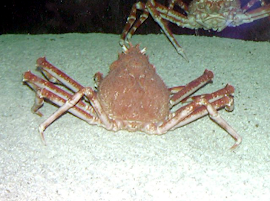
For this action project I decided to research the the very creepy Spider crab. 

In Binomial Nomenclature, the spider crab is seen as the Macrocheira kaempferi. I wanted to chose this organism because of it's long legs and because I thought it looked like something that didn't even exist. When I found out that I did still exist I wanted to go straight into researching it. I also wanted to research it because I felt like it looked really unique and I thought it would be good for looking at its taxonomy, morphology, and other unique traits.
 
From my first research I learned that majority of spider crabs live on different Japanese coasts. Under the water most often inhabit the sandy and rocky bottom of the continental shelf and slope and live in the shallow waters as babies and go down to 150 - 600 meters deep as adults. Their diet consists of dead animals and sea plants. Most spider crabs spend their days searching the ocean floors for food and since they can’t swim this process might take a while for them to find it. 

Here's a chart I created to mark all of the spider crab's taxonomy and what traits are needed for an organism to be in each category:


Label 

Taxonomy 

Morphology 

1

Kingdom = Animalia 

This spider crab is a part of the animalia because it is multicellular, eukaryotic and without chlorophyll.

2

Phylum = Malacostraca

The spider crab is a malacostraca because it has a lot of legs and a lot of long body parts making it very unique.

3

Class = Decapoda

The Spider crab has a head, thorax, and abdomen that makes it a part of the decapoda class.

4

Order = Inachidae

The Spider crab is made up of the Inachidae crab family and contains 39 genres of crab families. 

5

Family = Macrocheira

The spider crab is Macrocheira because of its huge legs and smaller claws and because of how deep it lives in the ocean. 

6


Genus = Hyas

Hyas is a genus of a spider crab because of it’s long legs and pie shaped face

7

kaempferi

The spider crab is a Macrocheira kaempferi because of its specific body temperatures living at around the surface where the water is more shallow at depths at 50 meters.  When they get older they move deeper into the ocean to where it can be 300 meters deep.


 After looking up each of these levels of taxonomy I began a outline that I could use to create an bigger exhibit of the spider crab.  

From there I went on the make it into a full exhibit: 


In this exhibit I manage to analyze each taxonomic trait that I put on my outline above. I did get to all of the taxonomic traits but some of them like the class and genus were both really hard for me to analyze.

Organism differences: Spider Crab and Tiger


The spider crab is similar to a tiger because they are both a part of the kingdom animalia. That means that there are both living organisms and they both are multicellular, eukaryotic and without chlorophyll. They also share similar colors in shell and in fur since both are an orange shade. Even though this is true, there’s way more differences between the spider crab and the tiger. For starters the spider crab is an omnivore so they usually eat things like dead animals and sea plants. While the tiger is only a carnivore and only eats different kinds of meat. Another example is class groups and families. The spider crab is a part of the malacostraca class, meaning that it has three main body parts. Those being the head thorax, and abdomen. The difference being with the tiger is that it's a part of the mammalia or mammals class. This means that tigers have 3 middle ear bones, hair, and the production of milk that make the tiger a mammal . There are also a part of different families of organisms as well. spider crab is also part of the inachidae family, but the tiger is a part of the felidae family.  With that we can see that these organisms have way more differences than similarities.   

Heres a ven diagram that compares the two from each other:


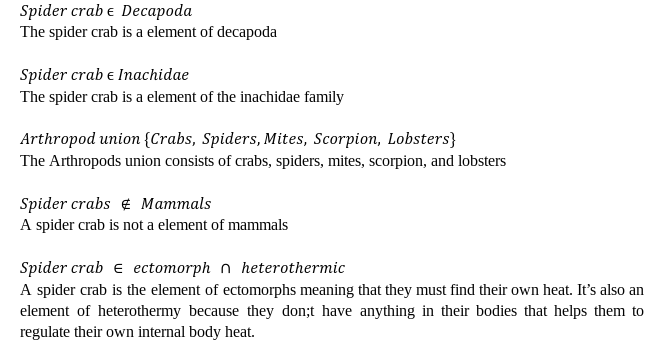
Here are some mathematical sets that relate to the spider crab:


Final thoughts:

This action project was related to my class population because we learned a lot about taxonomy and how to categorize different organisms from each other. We also got to go to the Lincoln park zoo where we also got to learn about the behaviors of chimpanzees and I also looked at the different behaviors of a spider crab in my action project as well. From this experience I learned that there are a lot of different organisms in the world and there are many different ways to classify,categorize, and compare them to one another. Thank you for viewing my blog and have a wonderful day.

Sources: 

  • Japanese spider crab, facts and photos. Animals. (n.d.). Retrieved October 4, 2021           https://www.nationalgeographic.com/animals/invertebrates/facts/japanese-spider-crab. 

  • Hudson, C. (n.d.). What is a spider crab? All Things Nature. Retrieved October 4, 2021

              https://www.allthingsnature.org/what-is-a-spider-crab.htm.

  • Riebel, W. (n.d.). Macrocheira Kaempferi. Animal Diversity Web. Retrieved October 4, 2021, from https://animaldiversity.org/accounts/Macrocheira_kaempferi/.

Analysis of a War about Nazis and how we fit in

This is my final action project for my class, Policy and for my junior year. This unit was split into two unit those being Execute and Judge...